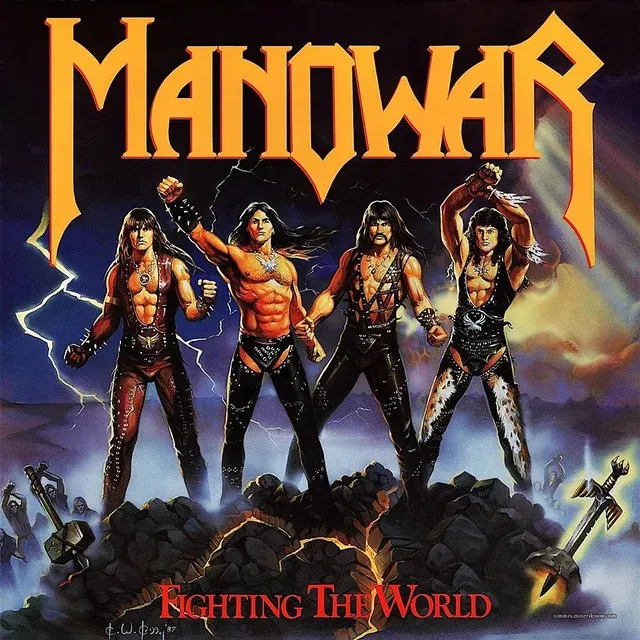
There is a curious immunity granted to excess. Whispers an unwelcome truth and you'll be viewed as a conspirator. Declare it beneath banners, with trumpets, drums, steel, thunder and theatrical flame, and you'll be dismissed as a buffoon. Yet the truth has entered the room all the same and with much less suspicion.
Manowar’s 1988 anthem Hail and Kill provides a useful specimen. Here was a song released in the late age of the great popular music inquisitions, when committees of anxious mothers, clerics, journalists and politicians concerned themselves with records, album covers, hidden messages, occult rumors and the moral education of the young. It was the age of the satanic panic, of hearings and warning labels, of a general suspicion that heavy music was a recruiting office for delinquency and damnation. Yet Hail and Kill, despite containing language that would today ignite whole provinces of commentary, passed largely as spectacle.
Its words are not merely fierce. They are barbaric. “Rape their women as they cry,” “Power and Dominion are Taken by the Will,” “May your sword stay wet like a young girl in her prime,” and “By divine right, hail and kill” are not lines composed for the sentimental conscience. Were such sentiments delivered today without theatrical mediation and by a band of white men, as Manowar were, they would be paraded as evidence of toxic moral infection. Every bureau of cultural supervision would find its proper cause. There would be accusations of toxicity, chauvinism, sadism and racialized male aggression. The liturgy is familiar.
Yet the song was not received principally as a manifesto of criminal intent. It was received as absurdly grand. It was too swollen with its own martial enthusiasm to be processed by the censor in ordinary terms. Its swords were too large, its gods too loud, its battlefield too drenched in crimson theatricality. The modern moral accountant, expecting the enemy to arrive in the modest clothes of plausible politics, did not know what to do with a barbarian entering on a chariot pulled by amplifiers.
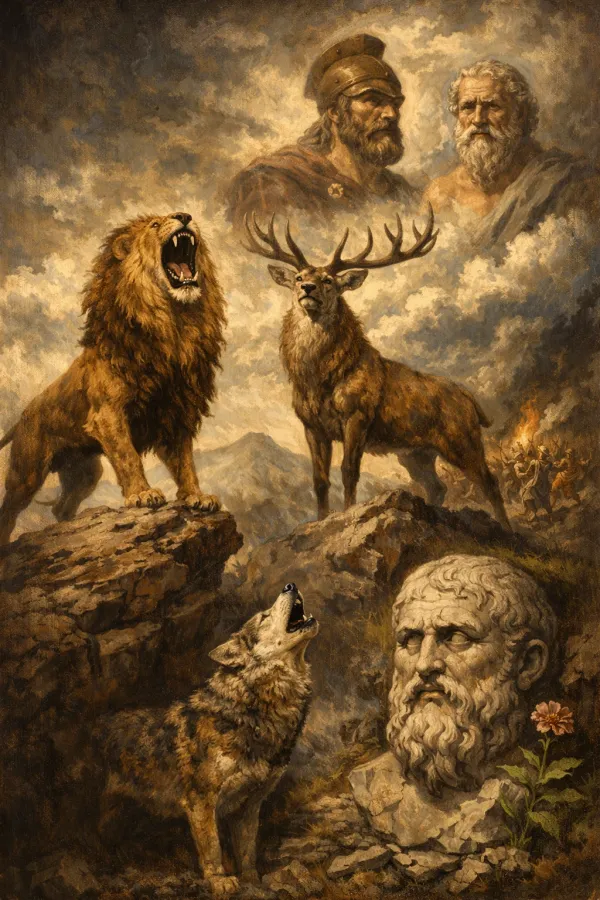
This is the more interesting because Manowar were not just dabbling in provocation and edginess. Some early metal acts used shock as a merchant uses colored glass. Blasphemy, blood and darkness were marketable ornaments. Manowar, by contrast, were attempting, in their extravagant fashion, to summon an older martial morality, particularly that of the Nordic conqueror. The song is strewn with northern images. “My father was a wolf, I’m a kinsman of the slain,” evokes koryos lineage. “Blood and death are waiting like a raven in the sky” calls forth the battlefield bird, that ancient witness of slaughter and sign of Odin. “The hammer of hate is our faith,” and “Together we will ride like thunder from the sky...hold your hammers high” are not subtle. They are invocations of a mythic world in which the hammer, the wolf, the raven and the slain are fundamental principles.
The morality expressed is, in essence, the morality found throughout the sagas and the heroic imagination of pagan Europe. Its virtues were courage, vengeance, loyalty, fame, domination and indifference to the tears of the defeated. It did not pretend that all men were equal souls moving through a seminar in procedural fairness. It understood life as contest, inheritance, oath and ordeal. A man was measured by what he dared, what he endured, what he avenged and what songs would carry his name after his body had been consigned to earth, fire or sea.
To the modern mind this is evil. It is toxic, chauvinistic, murderous, bloodthirsty and, worst of all in our present age, sincere about hierarchy. The pagan conqueror did not believe victory required the permission of the conquered. He did not suppose that dominion was a clerical error awaiting correction by humanitarian appeal. In the line “Power and Dominion are Taken by the Will,” one hears a principle far older than liberalism and far more common in history. It is not polite. It is not gentle. It is not safe. It is, however, recognizable to any serious student of mankind.
Here lies the paradox. When such truths are delivered in sober language, they are treated as dangerous. Say that human societies are founded upon force, loyalty, ancestry and sacred violence, and you may be accused of extremity. Sing the same thing as if standing shirtless upon a mountain, holding a sword above an army of thunder worshippers, and the guardians of public delicacy begin to laugh. They think no serious thing can be clothed in such extravagance. Their own contempt becomes the gate through which the message passes.
We need not pretend that the old barbaric code was merely fantasy. Men lived by it. Kingdoms were made by it. Seas were crossed under it. Monasteries burned before it. Dynasties took root where such men had come ashore. It was not a childish dream. It was one of the hard moral languages by which Europe learned war, lordship and civilization.
The comic element, therefore, does not refute the seriousness beneath. Rather, it protects it. Manowar’s performance is so grandiose that it disarms the censor. The modern critic looks upon the cuirass, the leather, the theatrical scream, the impossible masculinity and concludes that nothing here can matter. He mistakes the mask for the substance. Yet the young man with ears to hear receives a different instruction. He hears that there existed ages when men did not ask permission to be mighty, when faith was borne as a weapon, when ancestry was a summons, when the highest terror was not to be condemned but to be forgotten.
There is a lesson here for any people who wish to speak difficult truths in an age of cultivated fragility. The straight road is often watched. The solemn declaration is easily denounced. The cautious essay is scanned for heresy with priestly attention. But bombast, myth, laughter and artistic excess possess a strange diplomatic passport. They pass through the checkpoints because the inspectors are too proud to believe that anything wearing a horned helmet could be carrying contraband.
One may therefore speak in thunder. One may love reality with such immoderate force that the timid call it performance and let it go. One may proclaim hard things with such delight that the official mind files them under comedy. The joke, however, is not upon the singer. It is upon the censor who imagines that truth must always arrive in the costume of a policy paper.
The old world knew that songs carry memory where arguments perish. Men forget lectures, but they remember refrains. They forget footnotes, but they remember the wolf, the raven and the hammer raised against the sky. The sensible man, desiring to restore courage to a weakened age, should not despise theatrical force. He should study it. For sometimes the surest way to preserve a forbidden truth is not to hide it in shadows, but to set it ablaze in the open, so fiercely that cowards mistake the fire for fireworks.