The Architecture of Clandestine Fraternities Through History
"Three may keep a secret, if two of them are dead." — Benjamin Franklin, Poor Richard's Almanack, 1735
The student of history and statecraft will observe that wherever men of consequence have found the prevailing order insufficient to their designs, whether those designs be noble or base, revolutionary or restorative, the secret society has arisen as the natural instrument of their will. From the Pythagorean brotherhoods of the ancient Mediterranean to the Carbonari lodges that smouldered beneath the Austrian heel in Italy, the clandestine fraternity has served as both crucible and fortress for men who understood a truth seldom uttered in polite discourse: that all great endeavours begin in shadow before they command the light.
It is not the purpose of these pages to furnish a manual for conspiracy. Such an enterprise would be vulgar and better left to Colonial, and in any case, the particulars of conspiratorial method change with each generation whilst the principles remain eternal. Rather, this essay proposes to examine, with the dispassionate eye of the historian and the practical sensibility of the officer, how secret societies have been constituted in fact. What architectures of trust and selection have proven durable? What methods of recruitment have preserved an organisation's integrity? And what failures of discipline and judgement have delivered promising undertakings into the hands of their enemies? The record is instructive. For the aspiring officer of rank and the man of affairs, it offers lessons not merely antiquarian but immediately applicable to any enterprise requiring discretion, hierarchy, and the careful cultivation of reliable men.
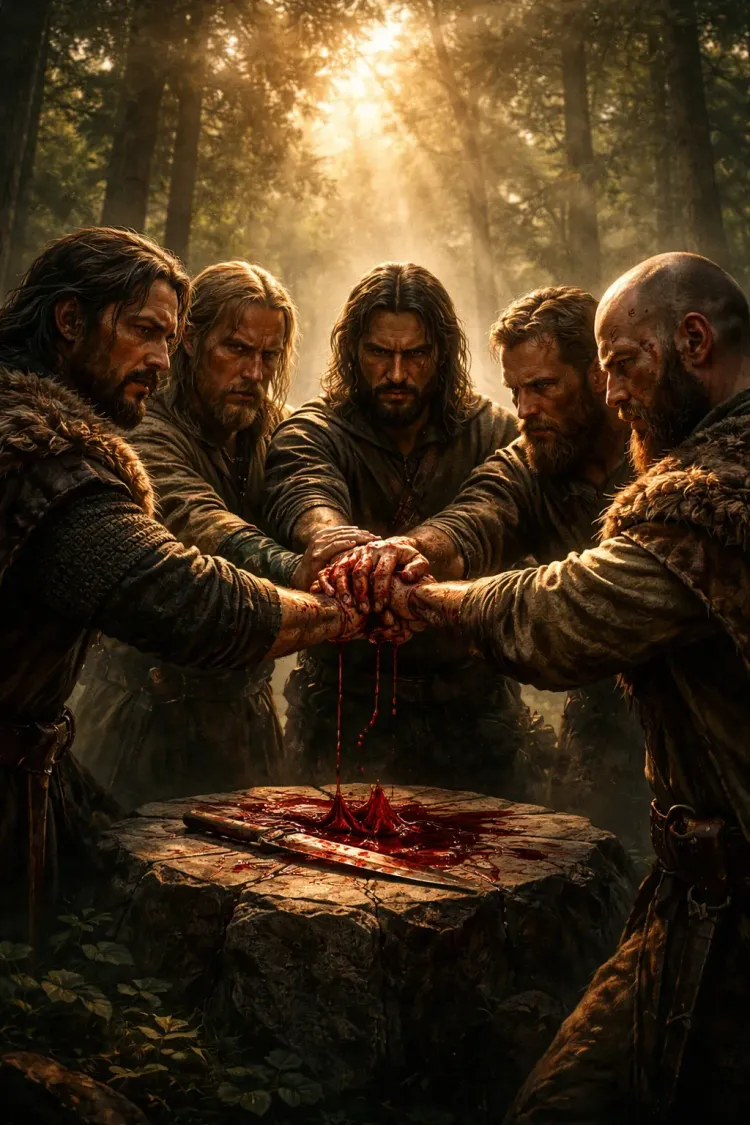
Every clandestine body confronts, at the moment of its inception, a difficulty which no subsequent elaboration of ritual, oath, or organisational hierarchy can remedy if it is not resolved at the outset. This is the problem of primordial trust, the question of how the founder, or founders, can be certain that the very first men admitted to the conspiracy will not betray it before it has acquired the resilience to survive betrayal. The matter is one of existential consequence. A society of a thousand members may absorb the treachery of one or two without perishing. A society of three cannot. History furnishes abundant illustration. The initial nucleus of any secret body is, by necessity, drawn from the circle of men already known to the founder through bonds antecedent to the organisation itself. Kinship, shared military service, long-standing commercial partnership, mutual participation in some prior ordeal: these are the ores from which the first metal of trust is smelted. No amount of oaths or ceremony can manufacture from whole cloth what must already exist in the sinew of lived experience between men.
The Pythagoreans of the sixth century BC understood this with a sophistication that would not be equalled for two millennia. Pythagoras did not open his doors to Croton at large. He selected from among his students and associates those who had already demonstrated, through years of philosophical discipline, a capacity for silence and obedience. Even then, admission was graduated. The akousmatikoi, or "listeners," were permitted only to hear the master's teachings from behind a veil, forbidden to speak, and subjected to a probationary period of five years before they might advance to the inner circle of the mathematikoi. The genius of this arrangement lay in its recognition that trust is not a binary state. A man is not simply trusted or untrusted. Trust is a quality that deepens by degrees and must be tested at each stage before further confidence is extended.
The same principle reappears across the centuries with remarkable consistency. When Adam Weishaupt founded the Order of the Illuminati at Ingolstadt on the first of May, 1776, his initial circle comprised no more than five men, all of them his students, all of them young, all of them known to him through the intimate and prolonged association of the university. The Areopagus, as he styled this governing council, was deliberately small, deliberately familiar, and deliberately composed of men whose characters Weishaupt believed he had already measured through extended personal observation. The Philike Hetaireia, that society of Greek patriots which laid the groundwork for the revolution of 1821 against Ottoman dominion, was founded at Odessa in 1814 by three men: Nikolaos Skoufas, Emmanuil Xanthos, and Athanasios Tsakalov. These three were bound not merely by a shared national aspiration but by the concrete and immediate bonds of commercial life in the Greek mercantile diaspora of the Black Sea region. They knew each other's characters not through philosophical abstraction but through the daily intercourse of trade, wherein a man's reliability and discretion are tested in small matters before great ones are contemplated. The lesson, then, is plain and admits of no exception: the founding nucleus must be composed of men already bound by trust forged in some prior crucible. The conspiracy that begins with strangers, or worse, with enthusiasts whose ardour has not been tempered by intimate knowledge of their persons, courts annihilation.
Once the founding nucleus is secured, the clandestine society must solve a second problem: how to expand its membership without diluting the trust that made its existence possible. Here the historical record presents two principal architectures, and most successful societies have employed some combination of both.
The first is the system of graduated degrees, perfected (though not invented) by the Masonic lodges of the seventeenth and eighteenth centuries. In this arrangement, the society is divided into concentric rings of initiation. The outermost ring knows little or nothing of the inner rings. At each stage of advancement, the member is tested through the performance of tasks, the demonstration of discretion, and the endurance of symbolic ordeals, before he is admitted to a deeper knowledge of the society's true purposes and methods. The operative genius of this architecture is that it transforms the problem of trust from a single, terrifying wager into a series of modest and recoverable experiments. If a man admitted to the first degree proves unreliable, he can betray only what the first degree knows, which, by design, is little of consequence. The loss is contained. The body survives. Only those who have passed through successive trials of character are entrusted with knowledge whose disclosure could prove fatal to the enterprise.
Weishaupt's Illuminati adopted this principle with extraordinary deliberation. His order comprised at least thirteen degrees, organised into three broad classes: the Nursery (including Novice, Minerval, and Illuminatus Minor), the Masonic grades (which Weishaupt grafted onto the existing Masonic structure to facilitate recruitment from within established lodges), and the Mysteries (divided into Lesser and Greater, the latter encompassing the ranks of Magus and Rex). The practical consequence of this system was that a Minerval might labour for years in the conviction that he belonged to a philosophical improvement society, wholly ignorant that the higher degrees harboured a political programme of considerable audacity. His ignorance was not a failure of the system. It was the system's central mechanism of defence.
The Carbonari of Italy, those secret revolutionary fraternities that so vexed the Austrian administration in the early decades of the nineteenth century, employed a simpler but no less effective version: two principal degrees, the Apprentice and the Master, with the political and insurrectionary objectives of the society revealed only to those who had attained the latter rank. The vendita, or local lodge, knew nothing of the larger national structure, and communication between vendite was conducted through carefully controlled intermediaries. Thus, even a successful penetration of one cell could not unravel the whole.
This brings us to the second great architectural principle: the cell, or compartmentalised unit. Whereas the degree system stratifies trust vertically, with each layer knowing more than the one below, the cellular structure distributes it horizontally, ensuring that each unit of the organisation operates in ignorance of the others. The principle is ancient. It was well understood by the leaders of early Christian communities under Roman persecution, who organised their congregations such that the capture and interrogation of one group could not expose another. But its most rigorous modern application belongs to the revolutionary movements of the eighteenth and nineteenth centuries. The Philike Hetaireia employed a branching recruitment structure in which each member was expected to recruit others, but no recruit knew the identity of anyone in the organisation beyond his own immediate sponsor. The leadership in Odessa, and later in Constantinople under Alexandros Ypsilantis, remained unknown to the vast majority of the membership, who received their directives through a chain of intermediaries.
The French revolutionary Louis-Auguste Blanqui, perhaps the most systematic theorist of insurrectionary organisation in the nineteenth century, refined the cellular principle to its logical extreme. His conspiratorial groups were organised into cells of no more than five or six men. Each cell knew nothing of the others. Communication with the central directorate flowed through a single liaison. If one cell was compromised, the damage was quarantined. The organism survived the amputation of a limb. The military officer will recognise in these arrangements a principle wholly familiar to him: the need-to-know basis upon which all intelligence operations have been conducted since the beginning of organised warfare. The clandestine society is, in this respect, nothing more than a permanent intelligence operation conducted against the prevailing political order, and it must be governed by the same iron discipline of information control.
If the founding nucleus is composed of men already known and trusted, how does the society grow beyond this initial circle? The methods are various, but the most enduring share a common characteristic: indirection. The direct approach ("I belong to a secret society; would you care to join?") is the mark of the amateur and the death warrant of the organisation. The successful recruiter never reveals the full nature of the enterprise until he is certain of his man. Instead, he proceeds by stages: first identifying a candidate through observation, then cultivating a personal relationship, then testing the candidate's sympathies through carefully calibrated conversations that approach the society's concerns obliquely, and only at last, when the candidate has in effect already committed himself in spirit without knowing it, extending the invitation.
The Illuminati were perhaps the most methodical practitioners of this art. Weishaupt instructed his recruiters, called Insinuators, to begin by compiling detailed psychological profiles of potential candidates. The Insinuator was to learn the candidate's character, his ambitions, his resentments, his intellectual tendencies, his personal weaknesses, and his circle of associates. He was then to befriend the candidate and, over a period of months, to steer conversations toward the themes of moral improvement, the corruption of existing institutions, and the possibility of reform through the association of enlightened men. Only when the candidate had demonstrated, through his own unprompted statements, a thorough sympathy with the order's principles was he to be informed that such an association already existed and that he might be found worthy of admission to it. This method was slow. It was laborious. And it was devastatingly effective, for a time. It ensured that each new member arrived at the threshold of initiation already self-selected and already psychologically committed. The vetting was organic, woven into the fabric of human relationship, rather than imposed through the mechanical formality of an interview or examination.
The Philike Hetaireia employed a variant: each new member was required to be vouched for by an existing member, who bore personal responsibility for the recruit's conduct. If the recruit proved treacherous, the sponsor bore the stain of that treachery upon his own honour, a powerful incentive to discriminate carefully. Moreover, the society demanded that each recruit swear an oath of the most solemn character, invoking divine wrath upon himself and his family should he betray the brotherhood. The efficacy of such oaths varied, naturally, with the piety and superstition of the individual. But in an age when men still trembled before the Almighty, the oath was no trivial thing.
The Freemasons, whose lodges have served as recruiting grounds for countless subsequent secret societies, perfected the most elegant mechanism of all: the open secret. Everyone knew the Masons existed. Their lodges were visible. Their charitable works were public. Their membership rolls, while not broadcast, were not rigorously concealed. This apparent openness served, paradoxically, as the most effective screen. Because the lodge presented itself as a fraternal and philanthropic body, which at its lower degrees it genuinely was, the man who joined at the first degree entered a world of convivial fellowship and moral instruction. Only gradually, over years, was he introduced to deeper currents. And at each stage, the lodge had ample opportunity to observe his character before deciding whether to advance him further or leave him contentedly at his present level. This is perhaps the most important insight the historical record affords: the most successful secret societies have hidden not behind walls of total secrecy but behind facades of apparent innocuousness. The society that is entirely invisible provokes no curiosity and recruits no one. The society that presents a benign exterior to the world attracts men of quality into an antechamber from which the most suitable may be drawn inward, while the rest remain usefully ignorant.
Against the foregoing successes, the historical record sets a catalogue of failures, some spectacular, some pathetic, all instructive. In nearly every case, the root cause of destruction may be traced to a violation of the principles already described.
The destruction of Weishaupt's order is the most celebrated case and the most richly documented. For all its sophistication in recruitment and degree structure, the Illuminati committed several fatal errors. First, Weishaupt expanded too rapidly. Intoxicated by the early success of his order, he relaxed his criteria for admission. Men were brought in who had not been subjected to the patient, months-long cultivation that the Insinuator method demanded. Among these insufficiently vetted recruits were men of unstable temperament, men of divided loyalty, and men whose commitment to the order's secrecy was shallower than their vanity. Second, the order became riven by internal dissension. Weishaupt's authoritarian temperament alienated several senior members, most consequentially the Baron Adolph von Knigge, who had been instrumental in grafting the order onto Masonic structures and who brought with him a large portion of the membership. When Knigge departed in 1784, he took with him both an intimate knowledge of the order's workings and a bitter resentment that made him indifferent to its survival. Third, and most immediately fatal, was the defection of several members who carried their knowledge directly to the Bavarian authorities. Joseph Utzschneider, a former member, submitted a detailed denunciation to the Duchess Maria Anna. Other disaffected members followed. The Elector Karl Theodor, already alarmed, issued edicts suppressing the order in 1784 and 1785. When the authorities searched the residence of Xavier von Zwack, a senior Illuminatus, they discovered the order's correspondence, internal documents, and membership records. That the order's most sensitive documents were kept in a single location, accessible to seizure, beggars belief from the standpoint of any competent practitioner of clandestine operations.
The lessons are threefold: do not expand faster than the mechanisms of trust can sustain; do not alienate men who possess dangerous knowledge of your interior; and never leave your records concentrated and exposed to such easy capture.
A century and a half before Weishaupt, a conspiracy to assassinate Queen Elizabeth and liberate Mary, Queen of Scots, was betrayed from within before it could be set in motion. Anthony Babington, a young Catholic gentleman of more ardour than prudence, assembled a circle of fellow conspirators whose principal qualification was enthusiasm rather than competence. The fatal weakness was the circle's reliance on a courier, a brewer's drayman named Gilbert Gifford, who had been turned by Sir Francis Walsingham's intelligence service. Through Gifford, Walsingham's agents intercepted the enciphered correspondence between Babington and Mary. The conspirators, believing their communications secure, committed their plans to paper with a specificity that amounted to signing their own death warrants. The failure here was not merely one of signals intelligence. It was a failure of vetting at the most basic level. Gifford was not a man whose loyalty had been forged in any serious crucible of shared experience. He was a convenience, a man with access to Mary's place of imprisonment, and convenience is the enemy of security. The conspirators admitted him because they needed him, not because they knew him. Walsingham, it should be observed, understood the art of penetration with a mastery that ought to command the respect of every officer. He did not merely intercept the correspondence; he allowed it to continue, feeding the conspirators a sense of false security whilst he accumulated evidence sufficient to destroy them utterly. The lesson for the student of clandestine operations is sobering: the enemy who knows you exist but permits you to continue operating is far more dangerous than the enemy who moves to suppress you at once.
The Russian Decembrists offer a case study in the perils of ideological heterogeneity within a clandestine body. The Northern Society and the Southern Society, which together comprised the Decembrist movement, were populated by officers of the Imperial Army, men of education, rank, and genuine patriotic sentiment. Yet the two societies could not agree upon their ultimate objectives: the Northern Society inclined toward constitutional monarchy on the English model, whilst the Southern Society, under the influence of Colonel Pavel Pestel, harboured republican and even proto-socialist aspirations. This fundamental disagreement in purpose meant that the conspirators were never, in the deepest sense, members of the same enterprise. When the moment of action arrived in December 1825, the result was a debacle: the revolt in Saint Petersburg was conducted with hesitation, confusion, and an almost total absence of coordinated command. Several members defected or simply failed to appear. Under interrogation, many broke rapidly and betrayed their associates with a thoroughness that the authorities could scarcely have hoped for. The Decembrists remind us that a secret society is not merely an administrative structure; it is a unity of brotherhood. Where that unity is absent, where the membership is bound by a vague sentiment, ideology, or principle rather than by concrete and mutual benefit, the organisation possesses an internal fragility that no amount of oaths or organisational ingenuity can overcome. Men will die for a cause they believe in with absolute clarity and men believe in their brothers more than any ideology. They will not die for a committee resolution.
The Society of United Irishmen, founded in Belfast by Theobald Wolfe Tone and others in 1791, presents perhaps the most instructive example of an organisation destroyed by the penetration of informers. Originally a public reform society, the United Irishmen were driven underground by government suppression in 1794 and reconstituted as a secret, oath-bound revolutionary body aimed at establishing an Irish republic with French assistance. The reorganised society adopted a cellular structure: committees of no more than twelve, grouped into baronial, county, and provincial committees, with a national directory at the apex. In theory, this structure should have provided considerable resilience against penetration. In practice, it was thoroughly compromised almost from its inception.
The difficulty was that the society, in its eagerness to build a mass movement capable of armed insurrection, sacrificed quality of membership for quantity. Tens of thousands were enrolled, a remarkable achievement of popular mobilisation, but a catastrophe for security. Among so vast a membership, the authorities found no shortage of men willing to serve as informers, whether from venality, coercion, or disillusionment. Samuel Turner, a member of the Leinster Directory itself, provided intelligence to the British government for years. Thomas Reynolds betrayed the meeting of the Leinster committee at Oliver Bond's house in March 1798, leading to the arrest of most of the provincial leadership on the very eve of the planned rising. The fundamental error was the confusion of a secret society with a popular movement. These are distinct instruments, suited to different purposes, and governed by different logics. A secret society derives its power from the quality and discretion of its members. A popular movement derives its power from numbers. The attempt to combine both, to build a mass army organised as a secret society, is a contradiction that has proven fatal in nearly every instance in which it has been attempted.
From the foregoing examination, certain principles emerge with sufficient consistency to merit the confidence of the prudent man. On the matter of founding: begin only with men whose trustworthiness has been established through prior bonds of kinship, shared service, commercial partnership, or prolonged personal association. Never begin with strangers, however sympathetic. Never begin with large numbers. Three to seven men of proven character form a nucleus more resilient than three hundred enthusiasts. On the matter of purpose: establish, before all else, a unity of purpose so precise and so thoroughly understood by every founding member that no ambiguity can later furnish a pretext for schism. A secret society divided against itself is a weapon pointed inward. On the matter of expansion: grow slowly. The rate of expansion must never exceed the capacity of existing members to observe, evaluate, and vouch for new recruits. Each new member should be the product of months, not days, of careful cultivation. The sponsor must bear personal responsibility for the conduct of his recruit. On the matter of architecture: stratify knowledge through graduated degrees, so that the compromise of any single level cannot expose the whole. Compartmentalise horizontally through cells, so that no member knows more of the organisation's extent than is necessary for the performance of his particular function. These two principles, vertical stratification and horizontal compartmentalisation, are the twin pillars upon which every durable clandestine body has been erected. On the matter of documentation: commit as little as possible to writing. What must be written must be enciphered. What is enciphered must be dispersed, never concentrated. The seizure of a single archive has destroyed more conspiracies than all the informers in history combined. On the matter of concealment: where possible, shelter the inner body within an outer structure of apparent innocuousness, be it a philosophical society, a reading club, a fraternal order, or a charitable foundation. This provides both a mechanism for observing potential recruits in a low-stakes environment and a shield of plausible deniability against external suspicion. On the matter of discipline: enforce absolute obedience to the principle that no member may reveal the existence of the society, the identity of its members, or the nature of its proceedings to any person not duly initiated. The penalty for violation must be understood in advance and must be credible. An oath that carries no consequence is merely theatre. And on the matter of the enemy: assume always that the adversary is competent, patient, and operating within your ranks. The society that believes itself impenetrable has already been penetrated. Vigilance is not a season; it is a permanent condition.
The history of secret societies is, at its foundation, the history of men who recognised that the prevailing order was insufficient and who possessed the will, the discipline, and the intelligence to construct an alternative in shadow. Some sought liberty. Some sought power. Some sought knowledge forbidden by the ignorance or timidity of their age. Their methods varied; their fundamental challenge did not. It was always the same: how to bind men together in trust and common purpose, how to protect that bond against penetration and betrayal, and how to grow without diluting the qualities that made the enterprise viable.
The budding officer and the statesman will observe that these are not exotic problems. They are the perennial challenges of leadership, organisation, and the management of men under conditions of adversity. The secret society merely confronts them in their most concentrated and unforgiving form, where the price of failure is not embarrassment or commercial loss but imprisonment, exile, or death. The examples here surveyed, the Pythagoreans, the Illuminati, the Carbonari, the Philike Hetaireia, the Freemasons, the Blanquists, the United Irishmen, the Decembrists, the unlucky conspirators of the Babington affair, collectively demonstrate that the architecture of clandestine organisation is not a matter of ingenious novelty but of rigorous adherence to principles as old as human society itself. Trust must precede structure. Structure must serve secrecy. Secrecy must be graduated, compartmentalised, and enforced with implacable discipline. Expansion must be subordinated to vetting. And above all, the men who comprise the body must be united not by sentiment but by an unambiguous and fiercely held common purpose.
Where these principles have been observed, secret societies have shaped the course of nations. Where they have been neglected, the result has been exposure, dissolution, and the gallows.
The record speaks plainly. It remains only for the discerning reader to hear.