The Wolf-God and His Pack: Odin, the Männerbund, and the Divine Origin of Sovereign Societies
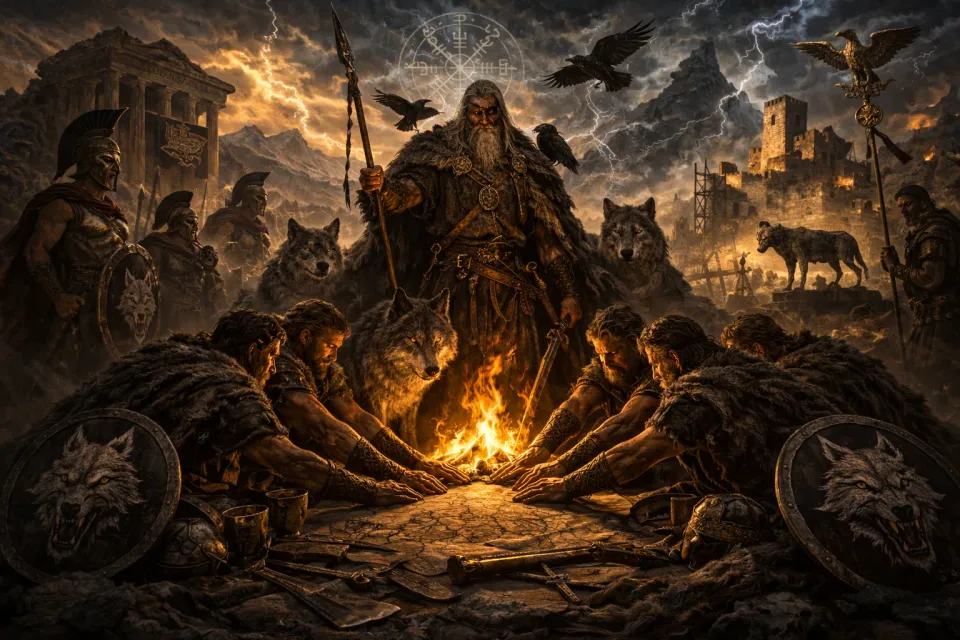
There is a species of modern man who, having been schooled in the comfortable opinion that civilization arose gradually from the soil, through agriculture, commerce, and the slow accretion of habit, considers the matter quite settled. He imagines ancient man as a farmer who one day decided to build a wall, then a city, then a legal code. He is wrong. Before the wall, before the granary, before the magistrate with his rod of office, there was the war-band. There was the pack. And above the pack, presiding over it with his single eye and his ravens and his wolves, there was Odin.
The insight I wish to press upon the attentive reader today is not merely mythological in its interest. It is structural. The comparative scholarship of Kris Kershaw, whose monumental study The One-Eyed God: Odin and the Indo-Germanic Männerbünde (2000) deserves far wider circulation than it has yet enjoyed among educated men. It demonstrates with formidable philological and anthropological evidence that Odin is not simply the chief of a Norse pantheon. He is the divine patron of a specific and ancient institution, the Männerbund, whose organizational logic is the very seed from which civilized order has repeatedly grown. To understand Odin in this light is to understand something essential about the nature of society itself, something that no textbook of political philosophy, however elegant, has quite managed to capture.
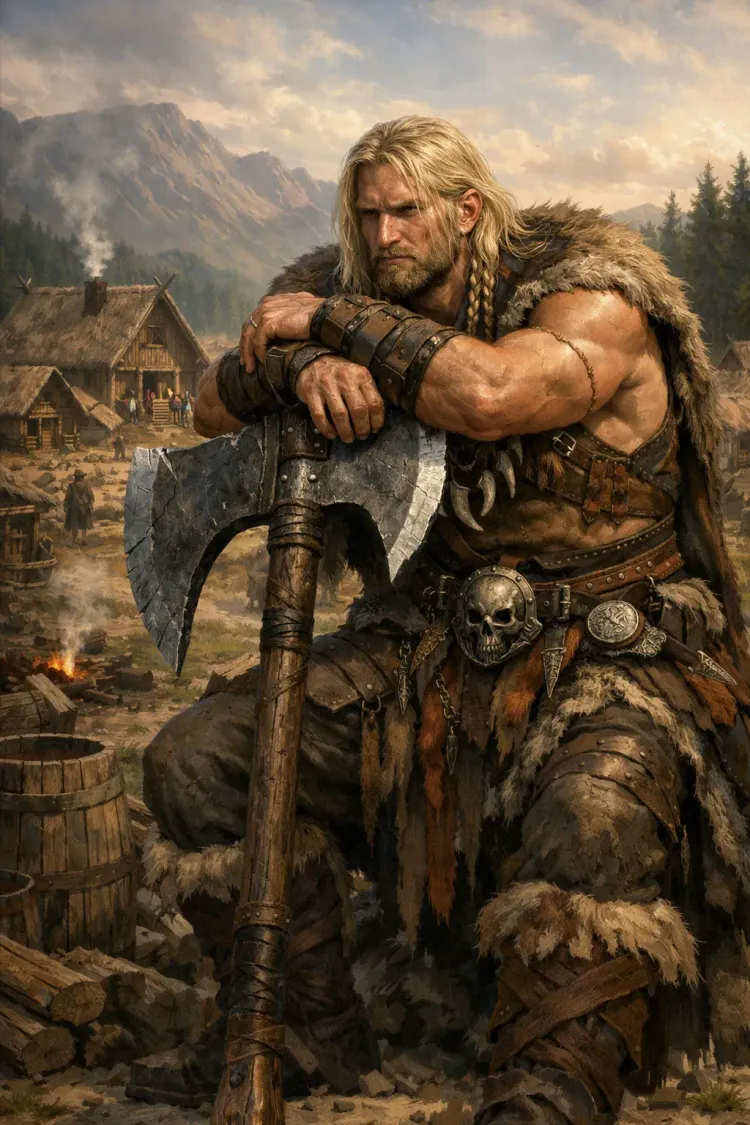
The term Männerbund, drawn from the German and meaning roughly "league of men" or "brotherhood of warriors," refers to an institution identified across the full breadth of the Indo-European world. It is not merely a word for any gathering of males. It denotes a specific initiatory structure: a band of young men, typically of noble or martial stock, who undergo a period of liminal existence outside the boundaries of settled society. They live in the wilderness. They dress in animal skins, most characteristically the skin of the wolf. They subsist by raiding, hunting, and the exercise of disciplined violence. They are bound to one another by oaths whose violation is treated as a species of sacrilege. And they are governed, in their wandering and their warfare, by a divine patron who embodies precisely their mode of existence.
Kershaw traces this institution through the Norse einherjar (Odin's chosen warriors in Valhöll), the Germanic Harii described by Tacitus as warriors who painted themselves black and fought by night, the Vedic Maruts who attend upon Rudra, the Greek thiasoi of Apollo Lykeios, and the Roman Luperci who run their ancient ritual in honor of Mars and the wolf-goddess. The convergences are not coincidental. They represent the survival, in varying states of preservation, of a single Proto-Indo-European institution of staggering antiquity. What is preserved in these traditions is nothing less than the organizational prototype of every subsequent form of Western male political association.
Odin's association with wolves is neither decorative nor incidental. He keeps two wolves, Geri and Freki, at his feet in Valhöll. His chosen warriors, the ulfheðnar, wore wolf-pelts and were believed to take on the nature of wolves in battle, a transformation described in the Eddic sources with the same language used for the berserkers, whose bear-shirts suggest an older and more widespread tradition of ritual animal transformation. Odin himself bears the heiti, the epithetical names, of the wanderer, the incognito traveler, the master of disguise, all of which mark him as the presiding intelligence of the liminal band, the god who exists at the edges of settlement, who cannot be housed or domesticated, and whose gifts come at a terrible price.
Kershaw establishes that the proto-Germanic root underlying many of Odin's names connects to concepts of fury, possession, and inspired madness, the wōð that gives us both the Old English word for poetry and the berserker's battle-trance. The Männerbund warrior was not merely a fighter. He was an initiate who had passed through a ritual death and rebirth. He had eaten of the wolf. He had, in some meaningful sense, ceased to be merely human, and it was precisely this passage through the non-human that equipped him to enforce higher standards on the human. The man who has run with the wolves and returned is a man who can build the fence.
The classical scholar will immediately raise an eyebrow at the inclusion of Apollo in this company, for Apollo is commonly presented, especially in his later, Hellenized form, as the god of light, reason, and harmonious order, the patron of the lyre and the oracle. Yet his oldest epithet, Lykeios, presents a rather less domesticated figure. Lykeios derives almost certainly from lykos, the Greek word for wolf, though a secondary tradition connects it to lykē, meaning light, and this verbal similarity is itself illuminating, for the wolf-god and the light-god are not opposites but phases. Apollo Lykeios was worshipped especially at Argos, where his sanctuary preserved traditions of considerable archaic ferocity. He was the god who drove away wolves, which is to say that he was the divine warrior who commanded them. The shepherd who prays to Apollo for strength to fight off wolves prays to the lord of wolves, and in the Männerbund tradition, the lord of wolves is also the patron of the young men who make themselves wolves and steal cattle from the shepherd.
This double aspect, destroyer and protector, wolf and wolf-slayer, is the functional signature of the Männerbund deity. The band of young warriors is a danger to peaceful society precisely because it possesses the qualities necessary to protect and enforce peaceful society. The wolf that guards the flock must itself be more dangerous than the wolf that threatens it. Apollo's connection to the Dorian Greeks, who were understood in antiquity to have been a conquering people whose martial austerity contrasted sharply with the more accommodating cultures they displaced, only strengthens the identification. The Spartans, who maintained perhaps the most self-consciously preserved Männerbund tradition in the classical world through their krypteia, wherein young Spartan men lived in the wilderness and practiced nocturnal violence against the helot population, regarded Apollo as their paramount divine patron.
The Roman material is, if anything, more explicit. Mars was not, in his oldest stratum, the bureaucratic war-god of imperial Rome, the deity who received prayers before conventional military campaigns. He was the patron of the Luperci, the brotherhood of priests who ran the Lupercalia, the most archaic of Roman religious festivals, on the fifteenth of February each year. The Luperci ran naked through the streets of Rome, striking women with strips of goatskin, in a ceremony whose fertility aspects have distracted commentators from its more fundamental character. The ceremony was performed at the Lupercal, the cave where the she-wolf had suckled Romulus and Remus, and this detail is key.
The founding myth of Rome is, at its core, a Männerbund myth. Romulus and Remus are exposed, nursed by a wolf, raised in the wilderness, and grow up to lead a band of landless young men, outcasts, refugees, the dispossessed, who seize territory, establish a settlement, and impose their law upon it. The rape of the Sabine women, whatever its historicity, is structurally the moment at which the Männerbund transitions into civil society, when the wolf-pack acquires wives, households, and the permanence of settled obligation. Rome is founded not by a philosopher-king contemplating the good but by a wolf-lord and his pack, who conquer first and legislate second. This is not a stain upon Rome's founding but its precise mechanism.
The Vedic tradition preserves the most archaic stratum of the Indo-European Männerbund deity in the figure of Rudra, the howler, the lord of the Maruts. Rudra is terrifying, dwelling in the wilderness, associated with storms, cattle disease, sudden death, and the forest's edge. He is propitiated rather than joyfully worshipped. His worship is conducted outside the village, at crossroads and liminal spaces, by men who have temporarily separated themselves from domestic life. He is the divine prototype from whom Shiva descends, and the Maruts who accompany him, the storm-gods, the divine warriors, display every hallmark of the Männerbund: they are young men of noble birth, they travel together in a pack, they are associated with the howling of storms, or dare we say of wolves, and they mediate between the controlled world of ṛta, cosmic order, and the chaos of unregulated nature.
That Rudra shares deep structural identity with Odin has been argued by several comparative mythologists, most recently through the framework provided by Kershaw and her predecessors in the tradition of Georges Dumézil, who spent a lifetime demonstrating that the Indo-European mythological inheritance reflects a coherent tripartite social structure. Rudra, Odin, Mars in his archaic form, and Apollo Lykeios all occupy the same functional position in their respective traditions: the warrior-god of the second function, but specifically the god who governs the liminal margin between ordered warrior society and the wilderness, who is the patron of the most dangerous and most necessary men, the men who make civilization possible precisely by being willing to exist, at times, outside of it.
Having established the comparative evidence, let us press toward the conclusion that matters most for men who are not merely scholars but practitioners of the principles under discussion. The Männerbund is not simply an interesting anthropological curiosity, the kind of thing one discusses over port wine and forgets before morning. It is the answer to a question that every serious man must eventually confront: how does order arise from disorder? How is that order maintained? How does a people come to possess a territory and govern it with a set of standards by against which conduct can be judged and found wanting?
The answer, which every mythology of the Indo-European world encodes and which modern political theory has conspicuously failed to provide, is as follows. A small group of men, bound by oaths and tested by shared hardship, acquires the capacity for coordinated violence. Through the exercise of that capacity, they establish shared standards of behavior and a territory. Having established a territory, they find themselves possessed of something worth defending. The act of defense requires further standards: who stands watch, who receives the larger portion, who may speak in council. These rules and the ability to enforce them are the embryo of civilization. The wolf-pack builds the city.
This is not a metaphor. It is the structural history of every Western civilization of which we have adequate record, and the mythological record preserves the memory of it in the figure of the wolf-god and his pack. When Romulus plows the pomerium, the sacred boundary of Rome, he transforms the Männerbund into the res publica. When the einherjar feast in Valhöll, they await the moment when their disciplined violence will be required to defend the cosmic order against Chaos. The myth encodes the function.
The wolf is not merely a symbol of ferocity. He is, in his pack, a creature of strict hierarchy and observed protocol. The alpha does not feast simply because he is strongest, but because the pack's discipline has established that the one who leads the hunt eats first. This is a standard. And it is precisely the capacity to establish, observe, and enforce standards that distinguishes the Männerbund from a mere mob. A mob possesses numbers and temporary fury. A Männerbund possesses something far more formidable: the habituated willingness to subordinate individual appetite to collective function, on the understanding that collective function alone produces outcomes that individual appetite never could.
When the Roman legion carried its aquila, its eagle standard, into the field, it was carrying the emblem of precisely this principle. The standard does not merely identify the unit. It obligates the men beneath it to a specific code of conduct, a specific hierarchy of obligation, a specific set of consequences for violation. The standard is the visible form of the internal covenant that every Männerbund must possess if it is to be more than a rabble. Lose the standard and you lose the covenant. Lose the covenant and you have a collection of armed individuals, dangerous perhaps, but incapable of the coordinated purposiveness that alone can establish and maintain order.
This is why the gods who preside over the Männerbund are not simply gods of violence. Odin is the god of wisdom, of poetry, of rune-knowledge; he hanged himself upon Yggdrasil for nine days to win the runes, which are both a writing system and a cosmological grammar, a set of standards by which reality itself is legible. Apollo is the god of the oracle, of music, of harmonious proportion. Rudra, in his Shaivite development, becomes the great ascetic, the lord of yogic discipline. Mars is not only the god of war but the guarantor of Roman pietas and the boundary-guardian of the Roman world. In every case, the wolf-god is also, and perhaps primarily, the standard-bearer, the deity who insists that violence must be disciplined, that the pack must operate according to codes that transcend the base preferences of any individual wolf, reaching instead for something higher.
The melancholy of the present age consists in this: that the institutions which once housed and channeled this ancient organizational logic have been progressively dismantled, diluted, or deliberately subverted. Men have been encouraged to believe that allegiance to abstractions is nobler than allegiance to one another, that hierarchy is oppression, that standards are arbitrary. The gods who preserved the memory of the Männerbund's civilizational function have been dismissed as quaint superstitions or, worse, repackaged as entertainment, stripped of the structural wisdom they were designed to encode.
But the wolf does not become something else simply because he has been told to be something else. The logic of the pack - loyalty, hierarchy, shared hardship, enforced standards, coordinated purpose - remains the only logic by which men have ever built anything that endures. Odin and his wolves, Apollo as wolf lord, Rudra and his howling Maruts, Romulus and his she-wolf: they are not the primitive fantasies of a superstitious age. They are the distilled intelligence of a civilization-making tradition, preserved in mythological form against the day when men who understand them are ready to act upon what they teach.
If this blog resonates with you and you're ready to use the tools discussed herein, contact me. We need to build a future of sovereignty. I've created a private space to further discuss how this might be done. Use Signal or Threema to contact me for access. -Colonial