To Love Life and War
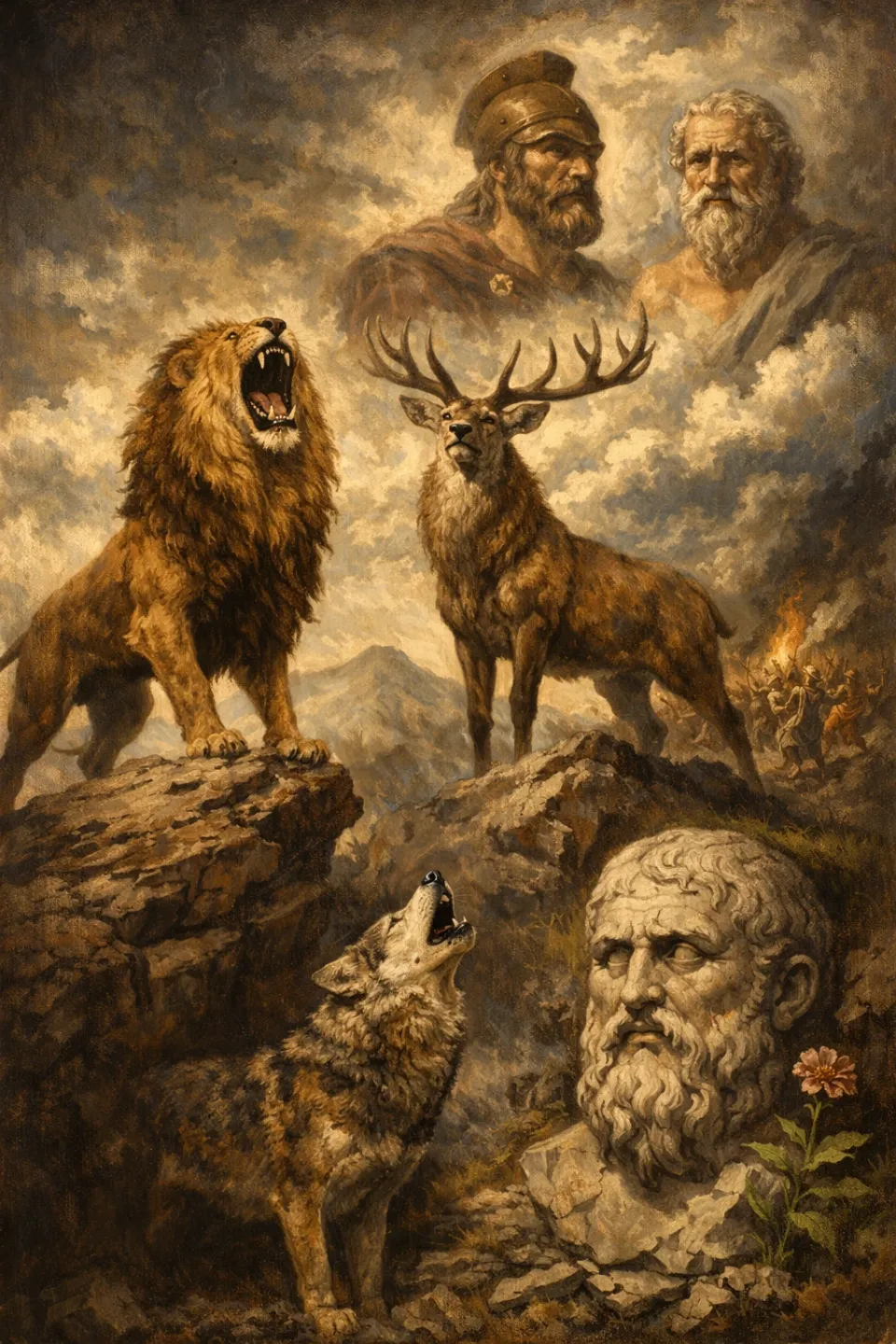
A few days ago my teenage daughter asked me why there doesn't seem to be any great modern philosophers. She's been reading Nietzsche, and she quickly sensed that his quarrel with modern thought runs deeper than a few academic disputes. He does not merely disagree with modernity. He suspects it. He regards it as evasive, moralizing, and fundamentally dishonest about the nature of life itself.
As we talked, my answer took a more definite shape than I expected. The matter is not, I think, that modern men are less intelligent than the ancients, nor that our age lacks information, technical sophistication, or institutional power. It is rather that this world is war, and modern thinkers hide from it. They wish to interpret life while refusing its governing law. In doing so, they're unable to produce philosophy in the old and noble sense. Instead we get commentary, therapy, and administrative ethics for a declining civilization.
One must begin with the obvious fact that all life exists in a condition of struggle. Picture the dominant buck standing on the mountainside, silhouetted against the dawn sky. He appears to us beautiful, serene, regal even. Yet everything that made him so was bought at a price. He had to survive the winter, endure hunger, resist disease, outrun predators, contend with rivals, and display such strength and splendor that he might win territory and the right to reproduce. His form is not accidental. It is the visible result of hardship met and won. His life has been no peaceful drift. It has been contest from the beginning and all of his winning was done at the expense of every buck that failed.
The same truth appears everywhere for any man willing to look. The wolf does not inherit his station without trial. The lion does not reign by sentiment. The elephant’s grandeur is not a withdrawal from danger, but the fruit of long endurance in a world that tests everything alive. Even the plant kingdom, which sentimental minds imagine to be gentle and passive, reveals the same principle. Trees rise against one another for light. Flowers compete for the attention of the bee. Roots spread in silent conquest beneath the soil. Every living thing presses outward, upward, or forward against resistance and at the expense of the losers. Life does not apologize for this condition. It fulfills itself through it.
What is striking is that nature nowhere seems embarrassed by struggle. The buck does not interpret his suffering as an injustice. The oak does not demand relief from the burden of growth. They do not pity themselves. They do not seek a tribunal before which they may accuse existence of cruelty. Rather, they become what they are through the ordeal proper to their kind and relish in it. Their striving is not a defect in life. It is life.
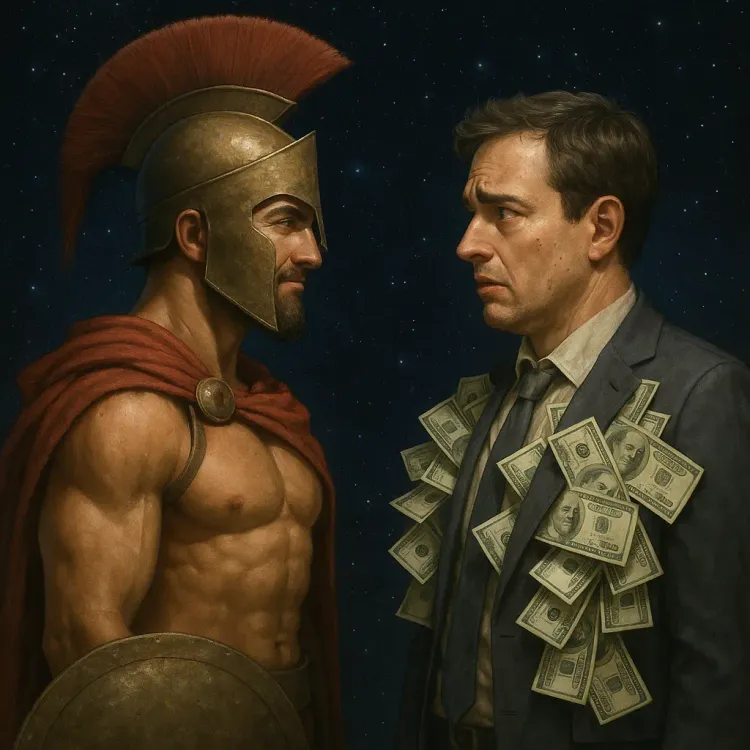
Now contrast this with the modern academic mind. The ruling ambition of the contemporary intellectual class is not greatness but insulation. Its institutions are built to minimize discomfort, reduce danger, and moralize against every hard feature of reality that cannot be legislated away. In such a world, suffering is no longer understood as master, or a companion of higher development. It is treated as the supreme evil, the one thing from which all decent arrangements must protect us. Comfort becomes the hidden god. Safety becomes the highest political good. Therapy replaces discipline. Inclusion and equality replace excellence. Procedure replaces judgment.
It is hardly surprising, then, that such a class fails to produce great philosophers. Great philosophy has never arisen chiefly from comfort. It emerged from civilizations that felt the full pressure of existence, and from men who were not sheltered from the tragic structure of the world and wouldn't want to be if they could. The greatest thinkers did not live in padded institutions devoted to the management of sensitivities. They lived close to death, ambition, civic achievement, military peril, exile, plague, dynastic collapse, and the demands of honor. Their minds were sharpened by necessity because necessity is clarifying. Men think most seriously when life refuses to flatter them.
The ancients understood something we've almost entirely forgotten. To know the world, one must not stand outside it like a critic behind glass. One must enter it, endure it, and finally learn to love it. This is not stoicism. Nor is it brute aggression, as though wisdom were reducible to violence. It is, rather, a disciplined affirmation of reality. The man who would understand life must accept that conflict, rank, loss, striving, sacrifice, and suffering are not accidental intrusions into an otherwise peaceful order. They are constitutive features of the human condition.
This helps explain why the ancient world produced thinkers of such commanding stature. Heraclitus could say that "war is the father of all" because he inhabited a world that had not yet learned to conceal the generative power of opposition. Thucydides wrote with unsurpassed realism because he saw how fear, interest, pride, and necessity moved cities and men. Even Plato, often misremembered as a dreamer of abstractions, wrote against the background of political collapse and civilizational crisis. These men did not philosophize in ignorance of struggle. They philosophized through it and because of it.
The same may be said of many of the strongest minds outside the classical canon. Their societies were not organized around the avoidance of pain, but around the struggle for excellence. They expected men to be tested. They understood that character is not cultivated in a vacuum, but in the field of obligation and risk. A civilization that still seeks honor, mastery, beauty, and permanence will ask ultimate questions with seriousness because those questions bear directly on how one ought to live. A civilization devoted chiefly to comfort will ask only those questions that can be made safe, professional, and grant-funded.
This is why so much modern philosophy feels bloodless. It is not that modern thinkers lack verbal dexterity. On the contrary, they are often exceedingly clever. But cleverness is a poor substitute for vision. The modern philosopher too often resembles a bureaucrat of concepts, endlessly refining terminology while remaining untouched by the deepest facts of life. He can analyze language, deconstruct narratives, and produce moral schemes of impressive complexity, yet he does not know what man is because he has spent his life trying to escape the conditions under which man most clearly reveals himself.
Nietzsche saw much of this. Whatever one makes of his conclusions, he understood that modernity had grown allergic to strength, hierarchy, tragedy, and noble aspiration. He recognized that an age devoted to comfort would eventually lose the ability to justify existence except on the flimsiest humanitarian grounds. Once suffering is regarded as a scandal rather than a tutor, and once struggle is treated as pathology rather than law, the soul itself becomes defensive and small. Such a civilization may still produce specialists, critics, and technicians. It will not produce sages, or any kind of great ones.
My daughter’s question, then, deserves a plain answer. There are few great modern philosophers because greatness requires confrontation with reality, and modern intellectual life is structured as an evasion of reality’s harshest terms. The world remains what it has always been: a theater of striving, contest, danger, beauty, and sacrifice - a theater of war. All living things know this except modern man, who has dedicated immense ingenuity to forgetting it.
Yet truth does not cease to rule because one finds it unpleasant. The buck on the mountain, the wolf eating the fawn, the tree reaching through the canopy toward the sun all testify to the same order. Life advances through trial. Form is born from pressure. Excellence demands cost. The thinker who would once again speak with authority must recover the courage to see this, to live it, endure it, and at last to affirm it without resentment.
Until then, we will continue to have many professors, many experts, and many critics. We will seek comfort, compassion, and an end to suffering as our highest values. And we will dwindle, becoming ever weaker, dumber, and uglier.
Perhaps some of us will recognize the need for more serious values. Imagine then the war we could wage if we would learn to love it. Imagine the frontiers we could conquer, the territory we could take, the strength and beauty we could summon. Men and women who could stand tall as the buck, in love with their competitive, conquering nature rather than resentful or ashamed of it. Dare we imagine it?