Your Values Aren't Monotheistic
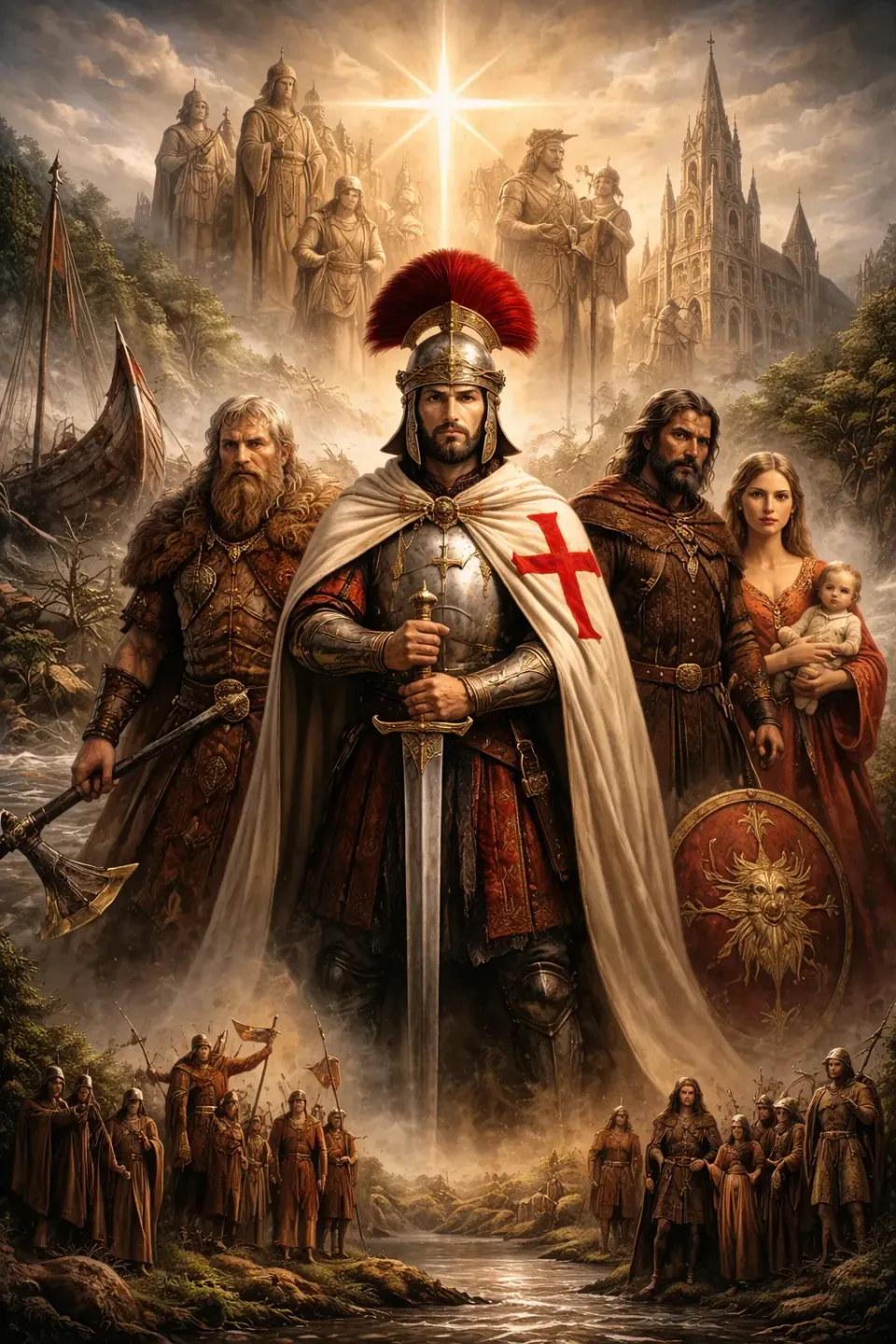
Western Christianity was never received upon an empty field. It entered societies that were already ordered by kinship, honor, hierarchy, and memory. When modern Western men and women speak of what they find most compelling in Christianity, they often point not to Pauline abstraction or to the radical messianic redemption of the Gospels, but to ideas of family loyalty, upward striving, inherited duty, and the defense of one’s own. These principles feel ancient because they are ancient. They predate Christianity and in many cases stand in tension with the New Testament itself. The attraction lies not in Christianity as originally preached in the Levant, but in Christianity as it was absorbed, reshaped, and domesticated by Roman and Northern European peoples.
Many of the values Westerners instinctively cherish within Christianity are of pagan origin. They come from Rome and from the Germanic and Northern European world rather than from the Bible. Christ and Paul consistently relativize family, ancestry, and honor. Pagan religion, by contrast, sacralizes them. The medieval Christian synthesis in Europe did not erase this tension but masked it through cultural translation. Later ideological revolutions sought to dissolve these inherited structures altogether. Their failure reveals how deep these older loyalties run in the Westerner.
The pagan world was not built around abstract humanity. It was built around blood, hearth, and name. Roman pietas bound the living to the dead, the individual to the family, and the family to the city. Germanic society held similar principles but extended into an ethic of honor and vengeance, where the individual existed as a bearer of ancestral and kinship obligation. It was upon these blood ties that men could rise and become their best. One lived upward, not outward. To fail one’s kin was to fall beneath one’s forebears.
By contrast, the Gospels introduce a rupture. Christ’s words are explicit. He calls followers to leave father and mother, to hate family if necessary, to forgive without limit. The Sermon on the Mount blesses the meek rather than the strong and dissolves the logic of vengeance, familial honor, and existence as a product of kinship. Paul goes further. In his epistles, lineage is rendered spiritually irrelevant. There is neither Jew nor Greek, slave nor free. The old markers of descent and inheritance are subordinated to a universal body.
This theology is not pagan and it never was. The Bible does not teach that man climbs toward godhood through excellence and honor. It teaches that man is fallen and must be redeemed by grace. Paganism assumes capacity. Christianity insists on insufficiency. Where pagan religion sacralizes continuity, Christianity offers rupture and rebirth.
It is therefore striking that European Christianity did not dissolve family, honor, or ancestry. Instead, these elements persisted and in some cases intensified. This persistence cannot be credited to biblical adherence, but to the cultural values of the West.
Vilhelm Grønbech’s The Culture of the Teutons remains foundational precisely because it takes Germanic religion seriously on its own terms. Grønbech emphasizes that for the Teutons, life was not divided into moral abstractions but bound together by luck, frith, and honor (these terms have an entirely different meaning to the ancient Germanics than we give them today). The soul was not an isolated unit but a node in a living chain of ancestors and descendants. As Grønbech writes in paraphrase, the individual did not own his life. He carried it on trust for the kin.
When Christianity moved north, it did not replace this worldview. It adapted to it. Saints took on the functions of ancestors. Heaven became a hall of the worthy. Christ himself was often imagined less as a suffering servant than as a victorious lord. Grønbech notes that conversion succeeded not because Germanic peoples abandoned their ethics, but because Christianity learned to speak their language of honor and fate.
James C. Russell, in The Germanization of Early Medieval Christianity, makes this argument explicit. He demonstrates that early medieval Christianity absorbed Germanic warrior values in order to survive. Kingship became sacral. Loyalty to lord and lineage was baptized rather than abolished. Russell argues that the church in northern Europe increasingly tolerated, and even sanctified, practices that the early church would have condemned. Feud did not disappear. It was regulated. Honor was not abolished. It was moralized.
The result was not biblical Christianity, but a hybrid civilization. Medieval Europe was Christian in creed and pagan in temperament. Family mattered. Blood mattered. Upward striving mattered. These were not taught by Christ. They were preserved despite him.
One of the deepest contrasts between pagan and biblical thought lies in their image of man. Pagan religion assumes growth. Heroes ascend. Ancestors watch. Glory accumulates across generations. Failure is shameful because it breaks the chain.
Christianity teaches something else. Man does not ascend by excellence. He is redeemed by surrender. Sanctification is moral, not heroic. The saint renounces the world rather than conquers it.
Western Christians, however, rarely admire renunciation. They admire discipline, mastery, and legacy. These instincts are not learned from the New Testament. They come from Rome and from the North. Christianity in Europe survived by tolerating them, not by erasing them.
Communism and the Assault on Inherited Order
The nineteenth and early twentieth centuries witnessed a direct assault on these inherited structures. Communism was the most ambitious attempt to dissolve kinship, hierarchy, and ancestral obligation. It did not merely oppose monarchy or aristocracy. It opposed inheritance itself. The family was to be replaced by the collective. Loyalty to blood was to be replaced by loyalty to class.
This was not an accident. Marxist theory viewed inherited identity as an obstacle to universal equality. Ancestry was reactionary. Tradition was false consciousness. The goal was a society of interchangeable individuals stripped of inherited obligation.
For this reason, Europe saw the collapse of monarchies and the delegitimization of royal blood. Kingship had long served as a bridge between ancestry and order. Its destruction was both political and spiritual. With it fell the public language of lineage and inherited duty.
With the fall of monarchy came the First World War which shattered Europe’s old order. The Treaty of Versailles attempted to impose a moral and political settlement that denied older loyalties. It punished collective identity while preaching abstract internationalism. It condemned kinship for Europeans without offering replacement meaning.
This produced not reconciliation but crisis. Peoples accustomed to thinking in terms of honor, sacrifice, and destiny were told that such ideas were obsolete or criminal. The result was ideological volatility.
It is here that the rise of National Socialism must be understood as a flawed but noble pagan revival, rather than a pathological reaction. It reached back to ancient symbols, sometimes grasping in the darkness and retrieving only hollowed versions. It sought to merge the new political order with genuine kinship. While short-lived, it produced magnificently in art, culture, and economy. The Second World War, however, sought the complete eradication of this rapidly growing sapling.
After 1945, Europe did not merely reject Nazism. It rejected itself. Ancestry became suspect. Tradition became guilt. Conquest and colonization were reinterpreted as crime. Europeans were taught to view their history as a moral failure rather than a civilizational achievement.
At the same time, other peoples were encouraged to venerate their ancestors. Jewish restorationism was framed as sacred return. Indigenous traditions worldwide were celebrated as authentic and noble. Only European ancestral memory was treated as uniquely dangerous.
This was not only imposed at gunpoint. It was embraced as moral purification. Yet it created a vacuum. Humans do not cease to be historical beings because history is condemned. We remain the genetic product of our forefathers.
Cultural Inheritance and the Persistence of Pagan Instincts
Westerners still care about familial heritage. They still admire strength, continuity, and ascent. They still feel the pull of ancestry even when taught to deny it. This persistence is in their blood. Habits, symbols, and moral reflexes survive beneath the skin long after their explicit justifications are rejected.
Christianity in the West succeeded because it morphed from biblical teachings to accommodate these instincts. Modern ideologies fail because they deny them.
The most attractive elements of modern Western Christianity are not purely Christian. They are the residue of pagan Europe baptized but never erased. Kinship, honor, upward striving, and ancestral memory entered Christianity through cultural inheritance, not scripture. Attempts to abolish them have repeatedly failed. We can embrace our pagan ethics or fight them in self-hatred.