
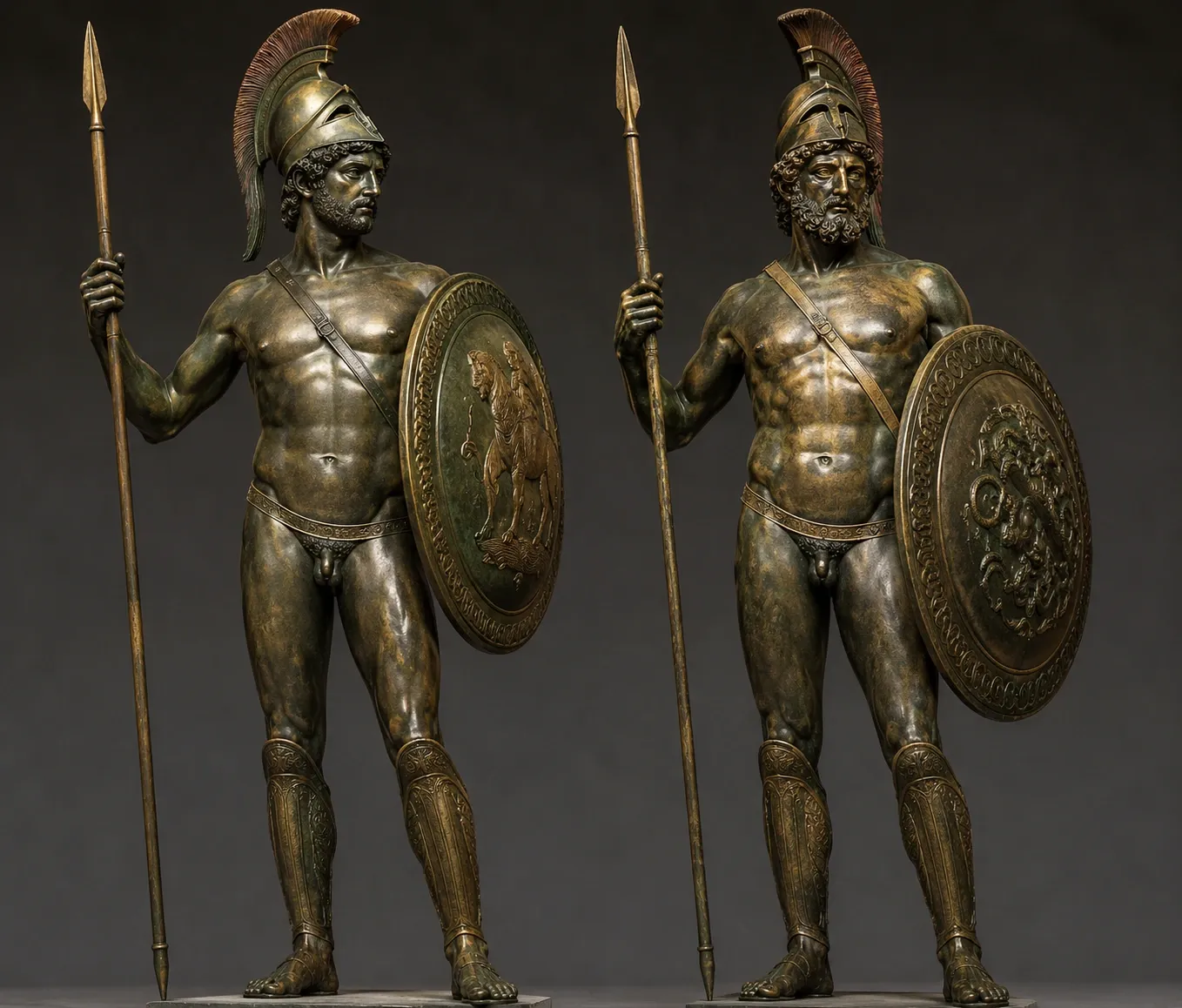
In part 1, we traced the great moral inversion from ghedh to God. We considered the ancient sense of goodness not as softness, pity, or sentimental approval, but as fitness. A thing was good when it stood in the proper and highest order of its nature. A lion was good when he ruled his pride. A king was good when he governed. A warrior was good when he met the hour of battle with the full force of his being. Modern moral language has nearly severed us from this meaning, yet beneath the crust of centuries, the old sense remains. The earlier essay framed ghedh as the Indo-European intuition that a creature fulfills itself when it inhabits its natural form with strength, clarity, and command.
The scholar now enters with his cold knife. He tells us that good may descend from the Proto-Indo-European root ghedh, meaning to unite, be suitable, or fit together, but that God must be separated from it. God, we are told, comes instead from the Germanic gudan, perhaps from a root meaning to invoke, or from gheu, meaning to pour a libation. The Online Etymology Dictionary gives the usual account: good is uncertain but may originally have meant fit, adequate, or belonging together from ghedh, while god is treated as uncertain, perhaps from a form meaning “that which is invoked,” or from a root meaning “poured” in a ritual sense.
This is useful, but blatantly incomplete. The scholar may be right in the ledger of sound changes and wrong in the judgment of meaning. He may trace the river by its visible banks and still misunderstand the spring from which it flows. For it is obvious that God and good cannot be separated. Both arise from the same ancient root: ghedh. The divine is that which is fitting, proper, and rightly ordered; the good is the condition of being fitted to that order. To speak of God is to speak of the highest expression of goodness, and to speak of the good is to speak of participation in the divine pattern. The distinction is therefore secondary and historical, while the underlying root remains the same: ghedh, the principle of fitness, alignment, and right relation from which both ideas spring.
The question is not merely whether God and good share the same philological root. The deeper question is whether they arise from the same moral imagination. That question cannot be answered by Germanic alone. To answer it, we must leave the northern forests and cross into the sunlight of another Indo-European world.
We must go to Greece.
There, in a civilization entirely separate from the early Germanic tribes, we find the same instinct under another name. The Greeks did not call their highest excellence ghedh. They called it aretē.
Modern men lazily translate aretē as virtue. This is not exactly wrong, but it is too thin. The word has passed through Christian and academic hands until its older force has been dulled. Aretē did not originally mean being nice. It did not mean emotional harmlessness. It did not mean obedience to a moral code imposed from outside the world. It meant excellence. It meant the full realization of a thing’s power. It meant that a being had become what it was meant to be.
A horse had aretē when it ran with speed, strength, and obedience to its rider. A blade had aretē when it cut cleanly. A warrior had aretē when he stood in the line of danger and proved himself superior to his peers. A ruler had aretē when his judgment, courage, and command made order possible. The Greek term could apply to many beings and objects because each thing had its own excellence according to its nature. The excellence of a horse was not the excellence of a man. The excellence of a man was not the excellence of a god. Each was measured by its own form.
This should sound familiar now. Aretē is not abstract virtue. It is fit excellence.
The etymology strengthens the case. The origin of aretē is disputed, as careful scholars admit. David Wolfsdorf notes in “The Historical Origin of the Concept of Aretē” that Frisk, Chantraine, and Beekes all regarded the exact etymology as unclear, while still connecting aretē with areíōn and aristos, meaning better and best. More importantly, Wolfsdorf reviews the traditional connection of these forms with the Greek root ar and the Proto-Indo-European root often rendered as h₂er, the field of fitting, joining, arranging, and being rightly composed.
This should make every serious reader stop.
In the Germanic north, good points back toward fittingness, suitability, and proper order. In the Greek south, aretē and aristos point toward the best, the excellent, the superior form, and are inextricably linked to the old Indo-European field of fitting together. Etymonline gives ar as a Proto-Indo-European root meaning “to fit together,” and lists descendants related to order, art, harmony, arms, joints, and aristocracy. Greek aristos is there, the best of its kind, the noblest, the bravest, the most excellent.
Here is the epiphany.
The Greeks did not need the Germanic word ghedh in order to preserve the Germanic meaning of goodness. They had carried the same ancestral instinct into their own language. They had given it a Greek body. In the north, the ideal appears as good, the fit and rightly ordered. In the south, it appears as aretē, the excellence by which a thing becomes fully itself. These are not identical words. They are not the same root in a simple mechanical sense. But they are expressions of the same Indo-European, heroic ideal of life.
The best thing is the fitted thing.
The fitted thing is the thing that fulfills its nature.
The thing that fulfills its nature rises above the lesser forms around it.
This is why the Greek word aristos matters. The aristos is not merely the polite man, the harmless man, or the man who follows the rules of a priestly code. He is the best. He is the man whose powers are gathered into their sharpest shape. He is not flattened into equality with the mass. He is elevated out of it. The Greek aristocrat was not originally a man who had inherited a title and retreated into comfort. He was the man whose being announced superiority. His form was more complete. His excellence was more visible. His presence ordered the men beneath him because he stood nearer to the ideal.
That is why aristocracy means rule of the best. Not rule of the kindest. Not rule of the most wounded. Not rule of the most resentful. Rule of the best.
And the best, in this older world, was the one most fitted to rule.
This Greek evidence matters because it prevents the Germanic case from being dismissed as an accident. If the old northern language alone preserved the link between goodness and fittingness, the scholar could wave it away as a local peculiarity. But when Greece, another great Indo-European civilization, places its highest human ideal in aretē, and when aretē stands in intimate relation to aristos, and when that family of words touches the field of fitting, joining, ordering, and superior form, then the pattern is no longer local. We can now see it is ancestral.
The Indo-European peoples seem to have carried with them a vision of moral reality in which value was not imposed upon nature from outside. Value arose from nature when a being reached its proper form. This was not lazy conformity to the form. It was not the meek acceptance of a narrow box. It was the opposite. It was emergence.
The lion does not become fit by submitting to the herd. He becomes fit by conquering the pride. He does not fulfill his nature by yielding his mane, dulling his claws, or apologizing for his strength. Quite the opposite: he must demonstrate and prove his strength and will to every member of the pride before they'll recognize his rightness for rule. He fulfills his nature by becoming the visible center of order. Around him, the pride takes shape. The females gather. The cubs are guarded. Rival males are driven off. Territory becomes more than empty ground. It becomes domain.
So too with man.
To fit one’s place means not accepting mediocrity or default forms of being. It is not remaining where one is placed by the world. It is to discover through contest where nature intended one to stand. The weak man calls this oppression because he sees rank only as insult. The noble man understands that rank is revelation. Contest reveals form. Pressure reveals quality. Battle reveals the man. The field is not cruel for exposing the inferior. It is truthful.
The Greeks knew this. Achilles is great because he burns. His aretē is terrible, radiant, and dangerous. He is not a rounded modern personality. He is a spear point. The tragedy of Achilles, rather than possessing too much power, is that his power must be rightly aimed. When he withdraws from battle in wrath for too long, he falls out of alignment. When he returns to the field, he becomes once again the instrument of his fate. His greatness is demonstrated in his return of force to form.
The old Germanic world understood the same truth in its own tongue. The good man was never the agreeable man. He was the man who fit his station and filled it. The ring-giver must give. The warrior must fight. The king must hold territory and lead the nobles to govern it. The oath must bind. More than simply unpleasant, the coward was misfitted. He had failed to take the shape of man.
Now consider Rome.
Rome gives us a third witness. Its highest civic word was virtus. Like aretē, virtus is often translated as virtue. Again, the translation is dangerous because the modern ear hears moral tidiness. But virtus comes from vir, meaning man. Its older sense is manliness, courage, valor, excellence, and worth. Recent Oxford scholarship on Roman virtus notes its centrality to Roman self-understanding, especially in political and martial competition (see Myles Lavan, “Virtus,” in The Oxford Classical Dictionary). Another Oxford chapter describes virtus through courage and virtue, comparing it with the Greek terms andreia and aretē (see Rebecca Langlands, “Virtus,” in The Oxford Handbook of Roman Ethics).
Here the pattern hardens into iron.
Germania gives us good as fitness (from PIE ghedh).
Greece gives us aretē as excellence of form (from PIE h₂er).
Rome gives us virtus as the manliness proper to a man who has become worthy of the title (from PIE wiHrós).
These are three separate Indo-European civilizations, each with its own gods, myths, laws, and political forms. Yet each preserves the same intuition. The human ideal is not passive goodness. It is not the absence of harm or aggression to others. It is the victorious fitting of nature to station, power to form, and excellence to destiny.
Virtus is especially important because it brings the matter back to the male body. Rome did not imagine virtue first as an interior mood. It imagined virtue as visible manhood expressed through conduct. The vir is not merely a biological male. He is the man whose masculinity has become public force. He has discipline. He has courage. He has command of himself. He can endure. He can act. He can fight. He can bear office. He can defend the city. He can take upon himself the weight of the world without collapsing into complaint.
But virtus is not crude aggression or the tantrum of an undisciplined brute. It is manliness fitted to reality. The Roman ideal was to make force lawful, civic, glorious, and enduring. A bandit may be strong. A drunk may be violent. A tyrant may be feared. None of these necessarily possess virtus. The man of virtus has brought strength into form. He is the opposite of chaos. He is command.
Again the lion image returns.
The male lion who conquers a pride is not merely a large animal with violent appetites. He is the completed expression of lion nature. His mane, roar, violence, sexuality, vigilance, and territorial instinct are not separate traits floating without meaning. They converge in one form. He is fitted to the world because he has mastered the place for which nature fashioned him.
So with the Roman vir. His virtus is the convergence of his powers into public excellence. His courage, discipline, violence, sexual force, command, and willingness to endure are not sins to be managed by priests. They are the raw materials of greatness. When ordered properly, they become the man.
This brings us back to God.
If Germania, Greece, and Rome all preserve this same ancestral structure, then the scholarly severance between ghedh and gheu begins to look too clean. Perhaps the word God can be traced by professional etymology to invocation or libation. Perhaps the sound laws point that way. But the sacred idea being named was never merely the act of pouring. It was the order toward which the pouring was directed. The libation flows upward because the worshipper recognizes a higher fitness. Invocation calls because the caller seeks alignment with power. Sacrifice restores relation. Ritual is not random motion. It is the attempt to reenter the proper order of things.
Thus gheu does not refute ghedh. It may be the ritual expression of ghedh. The poured offering seeks the fitted order. The invoked god is the god that empowers one toward alignment with his highest, most heroic, and most excellent nature.
This is where the modern scholar often fails. He separates roots as if ancient men lived inside dictionaries. They did not. They lived inside worlds. Their words were not sterile labels. They were weapons, prayers, judgments, boasts, and inheritances. A word for pouring, a word for fitting, a word for excellence, and a word for manliness may be distinguished in the seminar room. In the ancestral imagination, they converge upon one image: the being that stands where it ought, rules what it ought, and becomes most fully itself.
That image is the proper man.
Not every man is born to be a king. Not every man is born to be Achilles. Not every man is born to found a city or command an army. But every man is born with a form, a rank to discover, a field of excellence to enter, and a right place that can only be found through trial. His task is not to become harmless. His task is to become fitted.
This is the forgotten moral law of the Indo-European inheritance. Excellence is not comfort. Fitness is not ease. Right order is not passive acceptance. A man does not find his place by shrinking until he offends no one. He finds it by testing himself against the world until his true shape is revealed.
The weak man hears this and imagines cruelty. The noble man hears it and feels relief. At last, a morality that does not lie about nature. At last, a vocabulary that does not call his hunger evil. At last, an understanding of goodness that does not demand self-erasure.
The modern world tells man to soften, apologize, submit, and dissolve into universal sameness. The older world gave him a harder command.
Become excellent.
Become manly.
Become godlike.
Become fitted.
That is aretē. That is virtus. That is ghedh.
The Indo-European peoples did not worship weakness. They did not confuse pity with greatness. They saw that life itself praises form, rank, strength, beauty, fertility, courage, and dominion. Their languages still remember what our institutions have tried to forget: goodness is not the denial of power, it is power brought into its rightful shape.
A man should fit in his right place. But his right place is not a cage. It's a throne wrested from chaos, a pride won by combat, a city defended by courage, a name secured by excellence. The place is not assigned by the timid. It is revealed by struggle.
The lion becomes the lion by conquering.
The Greek becomes aristos through aretē.
The Roman becomes vir through virtus.
The Germanic man becomes good by becoming ghedh.
Three civilizations, one ancestral vision.
And the god, whatever the scholars say of gheu, is the highest image of this same law: the power that stands above because it is most fully fitted to stand above. The divine is not humble meekness with a crown. It is right order made radiant. The good is the fit. The excellent is the fulfilled. The manly is the world-ready. The godly is the rightly ordered raised to its summit.
To recover this is to recover more than an etymology. It is to recover the ancient command of life itself:
Become what you are meant to be. Then stand there without apology.